
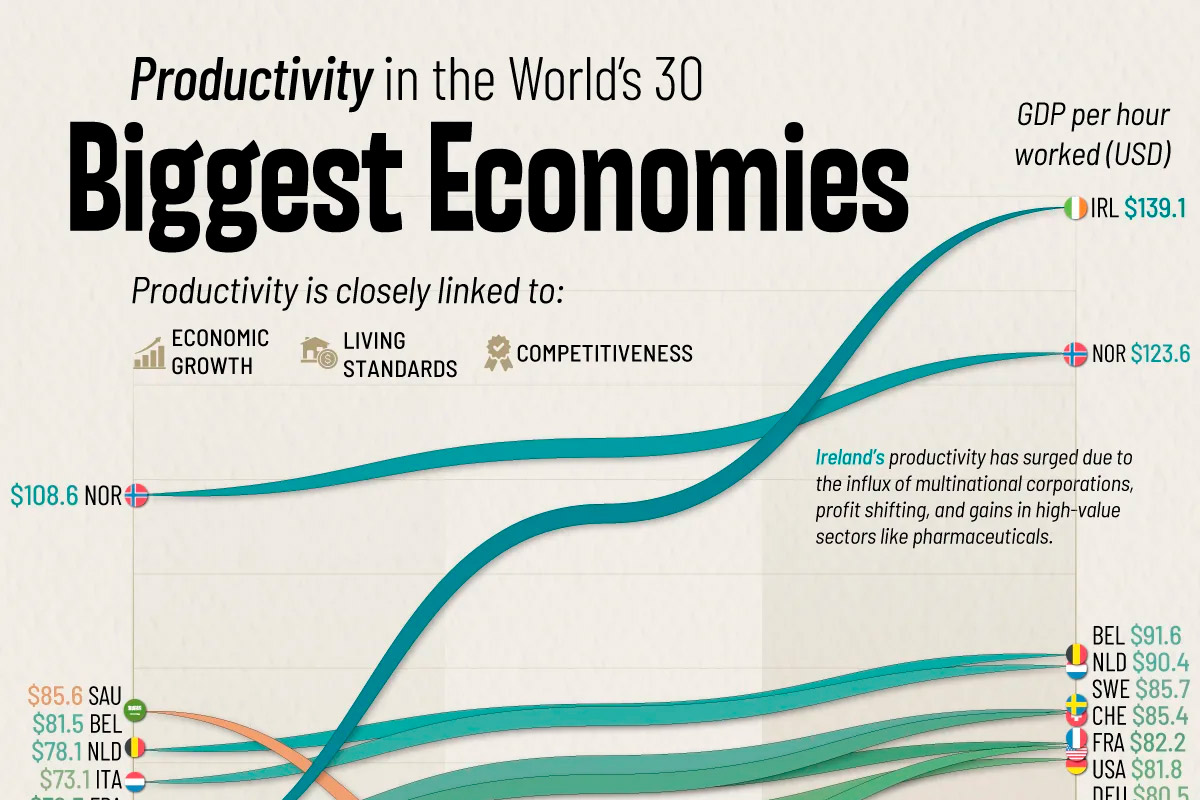

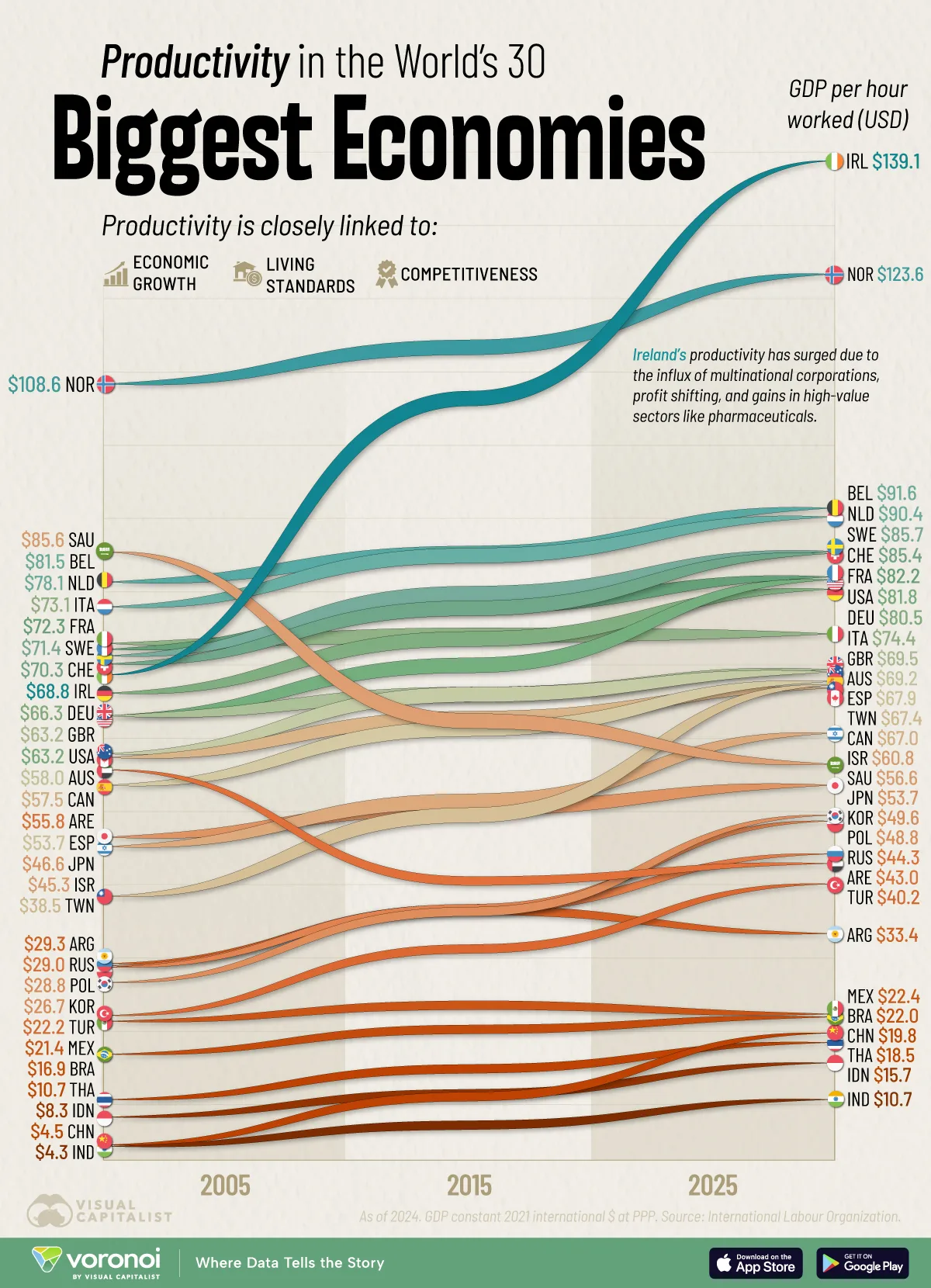
Productivity of the World’s Largest 30 Economies (2005-2025)
Economic productivity, measured by the value of goods and services produced per hour worked, is a key indicator of efficiency and overall prosperity.
This chart ranks the world’s 30 largest economies by GDP per hour worked (in U.S. dollars), revealing where output has grown or stagnated over the past two decades.
While advanced economies tend to dominate the top of the list, some emerging markets have seen extraordinary gains as they industrialize and integrate into global supply chains. The data for this visualization comes from the International Labour Organization (ILO).
Ireland’s Exceptional Productivity Surge
Ireland tops the ranking for productivity growth, with output per hour rising from $68.8 in 2005 to $139.1 in 2025—a 102% increase. However, much of this is statistical, not structural.
The presence of global tech and pharmaceutical giants like Apple, Google, and Pfizer inflates Ireland’s GDP figures through profit-shifting and intellectual property accounting.
China’s Growth Story Slows but Stays Strong
China’s productivity has increased from $4.5 per hour in 2005 to $19.8 in 2025, up more than 340%. The early 2010s brought massive efficiency gains as factories modernized, infrastructure expanded, and manufacturing became more sophisticated.

|
Rank
|
Country
|
2005
|
2015
|
2025
|
|---|---|---|---|---|
| 1 | 🇮🇪 Ireland | $68.8 | $106.6 | $139.1 |
| 2 | 🇳🇴 Norway | $108.6 | $113.6 | $123.6 |
| 3 | 🇧🇪 Belgium | $81.5 | $85.4 | $91.6 |
| 4 | 🇳🇱 Netherlands | $78.1 | $85.1 | $90.4 |
| 5 | 🇸🇪 Sweden | $71.4 | $79.9 | $85.7 |
| 6 | 🇨🇭 Switzerland | $70.3 | $77.9 | $85.4 |
| 7 | 🇫🇷 France | $72.3 | $78.2 | $82.2 |
| 8 | 🇺🇸 U.S. | $63.2 | $70.1 | $81.8 |
| 9 | 🇩🇪 Germany | $66.3 | $73.7 | $80.5 |
| 10 | 🇮🇹 Italy | $73.1 | $74.2 | $74.4 |
| 11 | 🇬🇧 UK | $63.2 | $66.1 | $69.5 |
| 12 | 🇦🇺 Australia | $58.0 | $66.1 | $69.2 |
| 13 | 🇪🇸 Spain | $53.7 | $61.4 | $67.9 |
| 14 | 🇹🇼 Taiwan | $38.5 | $49.6 | $67.4 |
However, growth has slowed in recent years. As wages rise and manufacturing matures, further productivity improvements increasingly depend on automation, AI integration, and service-sector innovation.
Oil Economies Show Mixed Trends
Productivity in Saudi Arabia has fallen from $85.6 in 2005 to $56.6 in 2025. The decline reflects both falling oil prices during the 2010s and OPEC+ production caps that curbed output. While diversification efforts under Vision 2030 are expanding non-oil industries, hydrocarbons still dominate the economy.
By contrast, Norway, another resource-rich economy, maintains one of the world’s highest productivity levels at $123.6 per hour, thanks to strong governance, sovereign wealth reinvestment, and a highly skilled workforce.
The U.S., Germany, and France have all seen consistent gains. The U.S. rose from $63.2 to $81.8, Germany from $66.3 to $80.5, and France from $72.3 to $82.2 over the 20-year span.
Western Europe continues to outperform on efficiency thanks to automation and worker training, while Japan and the UK have grown more slowly due to aging populations and stagnant investment.
Información extraída de: https://www.visualcapitalist.com/ranked-productivity-of-the-worlds-largest-30-economies-2005-2025/